
Everything You Know About Skincare is an Expensive Lie (Except This One Thing)
Turns out the dermatologists were right and the influencers were wrong, again.

I’m about to save you approximately $347 a month and seventeen minutes of your morning routine.
Here’s what you don’t need: the serum that costs more than your car payment, the essence that requires a YouTube tutorial to understand, the moisturizer made from snail mucus harvested under a full moon in Korea, or whatever new thing Gwyneth Paltrow is rubbing on her face this week.
Here’s what you do need: tretinoin 0.025%.
That’s it. That’s the tweet. That’s the whole article. You can go now.
But since you’re still here, let me explain why this little prescription tube is essentially a magic wand that dermatologists have been hoarding like Gollum with the ring.
What Even Is Tretinoin?
Tretinoin is a prescription retinoid, basically vitamin A on steroids (not literally on steroids, but you get it). It’s been around since the 1970s, which in skincare years makes it ancient, but unlike your high school boyfriend, it actually got better with age.
It does everything:
Speeds up cell turnover (translation: fresh skin shows up faster)
Boosts collagen production (your face stays bouncy)
Unclogs pores (goodbye, tiny forehead bumps you’ve had since 2009)
Fades hyperpigmentation (those dark spots from that one beach day in 2015)
Reduces fine lines (time travel, but make it topical)
Basically, it’s the closest thing we have to that scene in The Princess Bride where Westley goes into the machine and comes out mostly dead but then gets revived and is somehow fine. Except your skin comes out better than fine.
Real talk though: this isn’t overnight magic. You need to give it at least 12 weeks to see real results. I know we live in an instant gratification world, but your skin is playing the long game here.
My Super Sensitive Skin Can Actually Handle This (And That’s Saying Something)
Listen, my skin is ridiculously sensitive. If you look at my skin wrong on a Tuesday, my rosacea will flare and I’ll be red and irritated for days. The average face lotion is my enemy. I’ve returned more skincare products than I’ve kept. My bathroom cabinet is a graveyard of half-used jars that promised miracles and delivered inflammation.
So the fact that I’ve never once been irritated by tretinoin? Never once peeled? That’s pretty impressive, even to me.
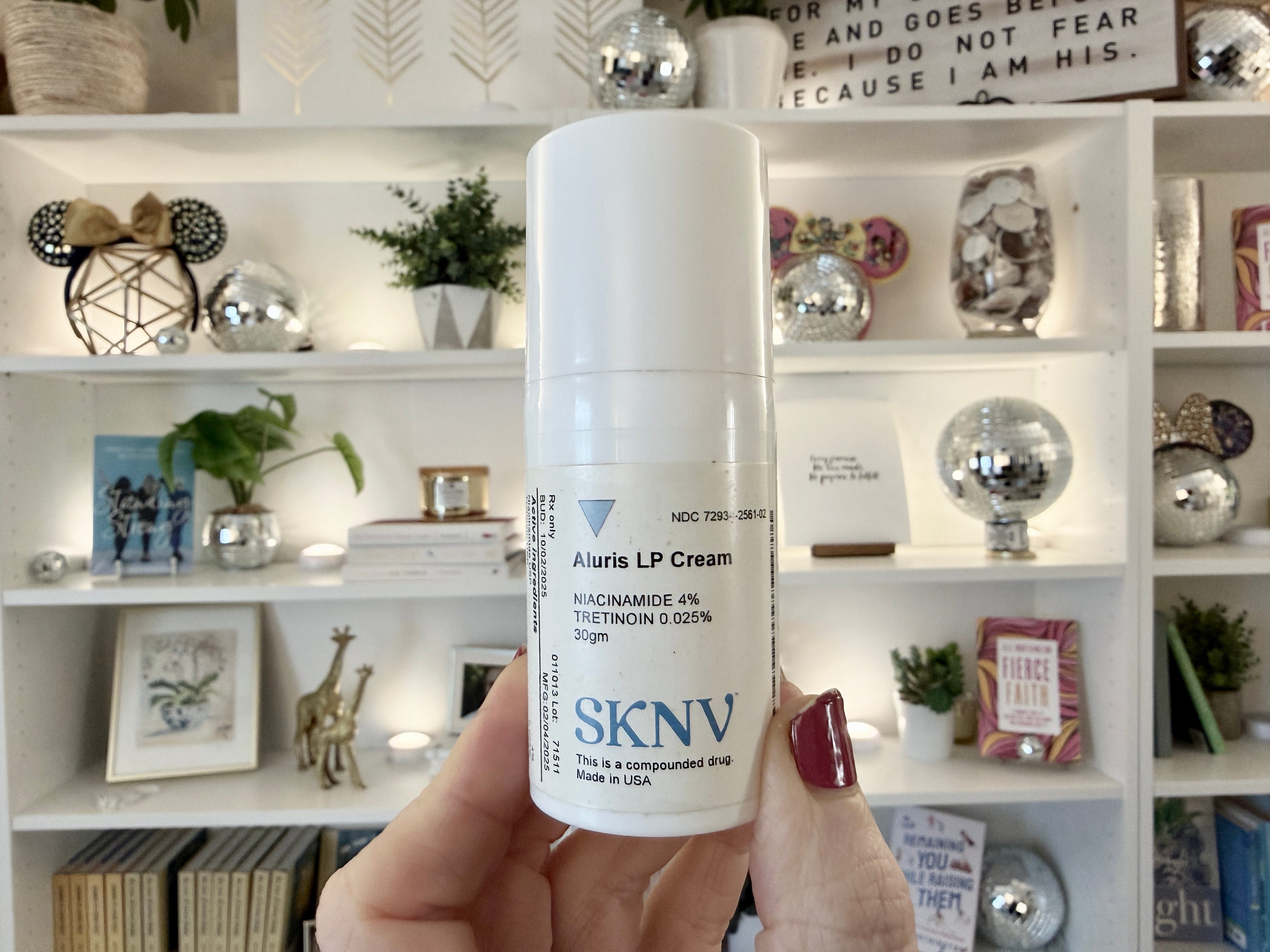
My doctor prescribes me Alluris LP cream, which has niacinamide 4% and tretinoin 0.025%, and I use it all over my face and neck with zero issues. My skin just... glows.
Now, is this everyone’s experience? No. Some people do have an adjustment period. But if my drama queen, rosacea prone skin can handle it, that should tell you something about the 0.025% concentration being genuinely gentle.
My results were so good when I went to my dermatologist to up the dosage. She explained that for anti-aging, 0.025% is all you need. A stronger dose won’t do anything for wrinkles or fine lines, but it will dry you out and irritate your skin.
Stop Doing What Instagram Told You To Do
Can we talk about the influencer skincare routines for a second? You know the ones where they’re dabbing lotion all over their face like they’re frosting a cake, using approximately ten times the amount any human needs?
It’s performative. It’s for the camera. It’s so you can see what they’re doing.
In real life? A pea-sized amount of tretinoin is enough for your entire face. More is not better. More just irritates your skin and wastes your prescription. Follow the actual directions from your actual doctor, not the person getting paid to make skincare look complicated.
How to Actually Use It (Without Ruining Your Face)
The routine is absurdly simple:
Night routine:
Wash your face (preferably with something gentle that doesn’t make you feel like you just baptized yourself in acid)
Wait until your face is completely dry
Use a pea-sized amount for your whole face (seriously, that’s all you need)
Wait 20 minutes
Put on moisturizer
If your skin gets extra dry, dab a little bit of Vaseline or Aquaphor over your moisturizer. It’s an occlusive, so it traps in moisture. You’ll wake up in the morning with baby soft skin.
Go to bed
Morning routine:
Wash if you need, I don’t.
Your favorite mousterizer/serum, only if you need one.
Sunscreen. SUNSCREEN. Did I mention sunscreen?
Tretinoin makes your skin more sensitive to the sun, so SPF 30+ every single day is non-negotiable. This isn’t optional. This is the price of admission. You can skip the fancy serums, but you cannot skip the sunscreen.
That’s it. No seventeen-step routine. No essences, no toners, no serums with unpronounceable ingredients. Just clean face, tretinoin, moisturizer, maybe some Aquaphor at night, and sunscreen in the morning.
But What About [Insert Expensive Thing]?
“What about vitamin C serum?”
Vitamin C and tretinoin together can make your skin way too sensitive. You’re basically asking your face to handle two powerhouse ingredients at once, and for a lot of people, that’s a recipe for redness and irritation. Tretinoin is already doing the heavy lifting on brightening and collagen production. You don’t need both.
“What about hyaluronic acid?”
Okay, here’s where everyone screws up hyaluronic acid. It’s a humectant, which means it pulls moisture from the environment. Sounds great, right?
Wrong, if you’re doing it wrong.
If you apply hyaluronic acid and then just... stop, or if you live somewhere dry, it has nowhere to pull moisture from except your own skin. Then it actually dehydrates you, and you end up drier than when you started. It’s a real hassle.
The RIGHT way: Apply it to damp skin, then immediately seal it in with a good moisturizer. The moisturizer traps the moisture so the HA can do its job.
But honestly? With tretinoin already in your routine, you probably don’t need the extra complication. Your moisturizer is doing just fine.
“What about the $200 eye cream?”
Your regular moisturizer is fine.
“What about that thing the influencer said I absolutely needed?”
She’s getting paid to say that. You don’t need it.
“What about...”
Stop. You’re doing the thing again. The thing where you complicate it because simple doesn’t feel legitimate. But simple works. Simple is cheaper. Simple doesn’t require a PhD to understand.
How to Get It- You Need to Actually Talk to a Doctor
Here’s the deal: you cannot get tretinoin without a prescription. And that’s a good thing, because you need to talk to an actual doctor about whether this is right for your skin.
I’m serious about this. Don’t skip the doctor visit. Don’t try to DIY this. Don’t ask your friend to share their prescription. Your dermatologist needs to evaluate your skin, discuss your medical history, make sure you’re not pregnant (tretinoin is a hard no during pregnancy), and determine if tretinoin is appropriate for you.
Tell your doctor you’re interested in tretinoin 0.025% and ask about formulations like Alluris LP cream. They’ll guide you on whether this concentration is right for you or if you need something different.
Once you have your prescription, it costs maybe $30 to $50 without insurance, sometimes less. A tube lasts months because you’re using a pea-sized amount.
Do the math: even at $50 every three months, you’re spending $200 a year on skincare that actually works instead of $200 a month on skincare that mostly just smells nice and makes you feel like you’re doing something.
The Actual Bottom Line
The beauty industry has convinced us that skincare needs to be complicated and expensive to work. That we need twelve products minimum. That if we’re not spending $100+ on a single serum, we’re not really trying.
But the dermatologists? They’ve known for decades that tretinoin does more for your skin than any cabinet full of luxury products ever could.
So yeah. Everything you know about skincare is probably wrong. Or at least overcomplicated and overpriced.
Talk to your doctor. Get the prescription. Use the pea-sized amount (not the Instagram amount). Wear your sunscreen religiously. Add moisturizer. Maybe some Aquaphor at night. Be patient for those 12+ weeks. Save your money for literally anything else.
Your skin will thank you. Your bank account will thank you. And you’ll never have to watch another 45 minute YouTube tutorial about layering essences again.
You’re welcome.
Love, Alli
Disclaimer: This is my personal experience with tretinoin, not medical advice. Your skin is different from mine. Talk to an actual dermatologist before starting tretinoin, especially if you’re pregnant, breastfeeding, have skin conditions like rosacea or eczema, or are on other medications. They’ll help you figure out if this is right for you and what concentration you need. And seriously, wear the sunscreen.
This is interesting. I'm wondering if my general practice physician would give this prescription or if I'll have to go to a dermatologist.